
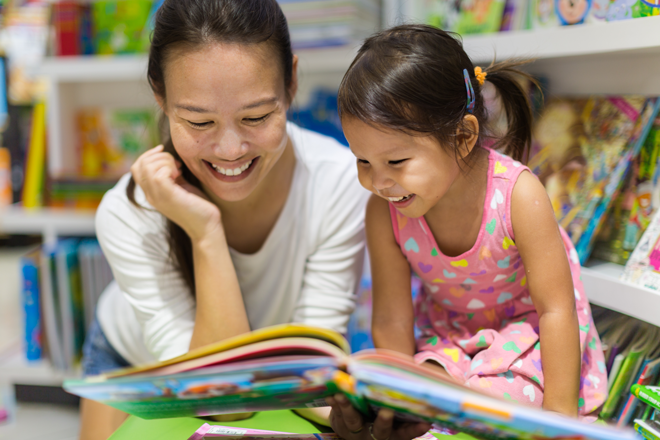
Reading with young children is more than just a bedtime routine, it can be an opportunity to support their learning and development. Sharing a book can spark meaningful conversations about emotions, relationships, and challenges. When you pause to wonder why a character is upset, explain what is happening, or listen to a child’s questions, you’re doing more than reading. You are helping children learn to name their feelings, build empathy, and solve problems. These small, back-and-forth moments, or what researchers call responsive interactions, are shown to support social and emotional development from infancy through early childhood (Fisher et al., 2016; Center on the Developing Child, n.d.n).
In this post, we’ll explore what the research says about how reading together and sharing stories can help young children build important social and emotional skills. You’ll find ideas for how to talk about feelings while reading with your child, what to look for in a good book that supports social and emotional skills, and some children’s book recommendations.
So, what does the research say about how stories support social and emotional skill development?
Shared reading routines create opportunities to talk about emotions and social situations. When parents or teachers ask their child questions during book reading or reference a character’s feelings in the story, it can support children’s social and emotional skills (e.g., Schapira & Aram, 2020; Bergen & Salmon, 2010). Don’t worry if your child wants to read the same book repeatedly! By re-reading, preschool children become more familiar with the story, and they are more likely to become more active participants in story time discussions (McDonnell et al., 2003).
 Stories can help children understand and name emotions
Using books with emotional content can improve children’s emotion understanding skills, such as increasing emotion vocabulary, knowledge, and recognition. Parents or teachers can support children’s emotion vocabulary and awareness by asking questions during shared reading time (“How do you think they feel?” “Can you show me that feeling with your face?”) or naming a character’s emotion out loud. In early learning settings, literature discussions can be done in small-group read-alouds or as part of circle time discussion to reinforce emotion vocabulary.
Try reading:
| Book Title | Author | Recommended Age |
|---|---|---|
| The Boy with Big, Big, Feelings | Britney Winn Lee | K – Grade 3 |
| The Color Monster Also available in Spanish: El Monstruo de Colores |
Anna Llenas | PreK – Grade 3 |
| When Sophie Gets Angry – Really, Really Angry Also available in Spanish: Cuando Sofia Se Enoja, Se Enoja de Veras |
Molly Bang | PreK – Grade 1 |
| Ruby Finds a Worry | Tom Percival | K – Grade 2 |
| In My Heart: A Book of Feelings Also available in Spanish: Así es Mi Corazón |
Jo Witek | PreK – Grade 1 |
| We Are Water Protectors Also available in Spanish: Somos Guardianes del Agua |
Carole Lindstrom | PreK – Grade 2 |
 Stories can teach about perspective-taking and empathy
Reading stories gives children the opportunity to practice seeing the world through someone else’s eyes, and introduces them to characters with unique backgrounds, problems, desires, and viewpoints. Shared reading can help children develop and practice empathy—the ability to put yourself in someone else’s shoes and understand and feel what they are going through. It can foster respect, compassion, and caring for one another. Parents or teachers can help children understand the feelings of others by asking questions such as, “How do you think the character is feeling?” “Why do you think the character is acting that way?”
Try reading:
| Book Title | Author | Recommended Age |
|---|---|---|
| Chrysanthemum Also available in Spanish: Crisantemo |
Kevin Henkes | PreK – Grade 3 |
| Last Stop on Market Street Also available in Spanish: Última Parada de la Calle Market |
Matt de la Peña | PreK – K |
| The Rabbit Listened Also available in Spanish: El Conejo Escuchó |
Cori Doerrfeld | PreK – K |
 Stories can model emotion regulation and problem solving
Stories can also be a great way to help young children learn how to manage big feelings and practice problem solving, particularly when the story includes a challenge that the child has experienced. Children can observe a character face a challenge, such as feeling left out, making a mistake, or having a difficult day, and see how that character overcomes them. Shared reading routines can provide a safe time for the parent or teacher and child to talk about overcoming challenges or managing big feelings. Parents or teachers may ask questions like “Have you ever felt that way too?” or “What helps this character feel better?” to start a discussion.
Try reading:
| Book Title | Author | Recommended Age |
|---|---|---|
| My Mouth is a Volcano Also available in Spanish: ¡Mi Boca es un Volcán! |
Julia Cook | K – Grade 3 |
| The Rough Patch | Brian Lies | PreK – Grade 3 |
| The Heart and the Bottle | Oliver Jeffers | PreK – Grade 3 |
| What If… | Samantha Berger | PreK – Grade 3 |
 Stories can help children see themselves and other life experiences
Books that tell stories of diverse life experiences, family structures, and cultures can be a powerful tool as your child is developing their sense of identity and belonging (e.g. Bishop, 1990; Enriquez, 2021). When children see themselves reflected in a book through the character’s background, language, emotion experiences, or family, they feel seen and valued. Including books with a range of characters and life experiences represented in stories can also help children build empathy, curiosity, and respect for people with different experiences.
Try reading:
| Book Title | Author | Recommended Age |
|---|---|---|
| Love Makes a Family | Sophie Beer | Up to PreK |
| We’re Different, We’re the Same | Bobbie Kates and Joe Mathieu | PreK – Grade 2 |
| Boys Dance | John Robert Allman | PreK – Grade 2 |
| Eyes That Kiss in the Corners | Joanna Ho | PreK – Grade 2 |
| Alma and How She Got Her Name | Juana Martinez-Neal | K – Grade 2 |
| The Proudest Blue | Ibtihaj Muhammand | PreK – Grade 3 |
Tips to support children’s emotional skills during shared reading routines
- Ask open-ended questions, like “Why do you think they did that?” “How do you think they are feeling right now?” “How do you know they feel this way?” This gives the child time to pause and reflect on the story and the character’s emotions.
- Model emotion language by using feeling words. For example, “He looks like he’s feeling embarrassed; his head is down, and his cheeks are red.”
- Connect the story to the child’s own feelings, challenges, or experiences. You might ask, “Has something like that ever happened to you? How did you feel?” or “Have you ever felt like that?”
- Read the book again! And again! Repetition deepens understanding and allows the child to learn new things after each read.
- Follow the child’s interest in the story and build on what they say. Letting the child take the lead can often lead to rich conversations.
So, how can I find a good book to support my child’s emotional skills?
You can use any book with a character with emotional depth and make time to read and talk with your child. Use your child’s favorite book or books that you have already read with your child. You can even use wordless books and invite your child to narrate and interpret the story in their own words.
Wordless books to try:
| Book Title | Author |
|---|---|
| Hug | Jes Alborough |
| The Snowman | Raymond Briggs |
| A Ball for Daisy | Chris Raschka |
| Chalk | Bill Thomson |
Here is a simple checklist for when you are looking for a book:
- Relatable character with real emotions
- A clear social or emotional challenge
- Resolution of problems or conflicts through reflection or dialogue
- Opportunities to discuss or ask questions
- Representation of different cultures, perspectives, and identities
We recommend that you visit your local library and ask your librarian for book recommendations. Educators can also collaborate with school librarians to create classroom libraries that reflect diverse cultural, social, and emotional experiences. Here are other places to find great books for your child based on their interests, age, and reading level:
- Best Books for Kids | Common Sense Media
- Resource | ZERO TO THREE
- EmbraceRace | Children’s Books
- Recommended Books for Young Children | Colorín Colorado (Book recommendations in Spanish language)
- Home | Lee & Low Books
See some of our research and evaluation projects related to parents supporting children’s social and emotional development and literacy skills.
- SRI research finds mobile messaging helps parents increase family quality time – SRI
- Literacy and language arts – SRI

Download and print:
How Stories Support Social and Emotional Skill Development
References
Center on the Developing Child at Harvard University. (n.d.). Center on the Developing Child. Harvard University. https://developingchild.harvard.edu/
Enriquez, G. (2021). Foggy mirrors, tiny windows, and heavy doors. The Reading Teacher, 75(1), 103-106.
Fisher, P. A., Frenkel, T. I., Noll, L. K., Berry, M., & Yockelson, M. (2016). Promoting healthy child development via a two-generation translational neuroscience framework: The Filming Interactions to Nurture Development video coaching program. Child Development Perspectives, 10(4), 251–256. https://doi.org/10.1111/cdep.12195
McDonnell, S. A., Friel–Patti, S., & Rollins, P. R. (2003). Patterns of change in maternal–child discourse behaviors across repeated storybook readings. Applied Psycholinguistics, 24(3), 323-341.
Schapira, R., & Aram, D. (2020). Shared book reading at home and preschoolers’ socio-emotional competence. Early Education and Development, 31(6), 819-837
Van Bergen, P., & Salmon, K. (2010). The association between parent-child reminiscing and children’s emotion knowledge. New Zealand Journal of Psychology, 39(1), 51.
Topics: Early childhood Educator professional development and support Family engagement Social-emotional learning