
Digital media and technology are woven into many parts of students’ lives, both in and out of school. Young people use digital tools to learn, express themselves, seek information, and participate in online communities. As a result, students bring their digital habits and interactions into the classroom every day.
A Multi-Tiered System of Supports (MTSS) framework offers a useful way to organize school-based supports for students’ digital well-being. Within MTSS, Tier 1 strategies are designed for all students. In the context of digital well-being, these strategies include schoolwide supports that help students navigate digital environments safely, responsibly, and thoughtfully. Providing media literacy instruction to all students is critical because it helps them build the skills they need to evaluate information, communicate responsibly, and make thoughtful choices in digital spaces.
Agents of Influence, a Game-Based Universal Media Literacy Support
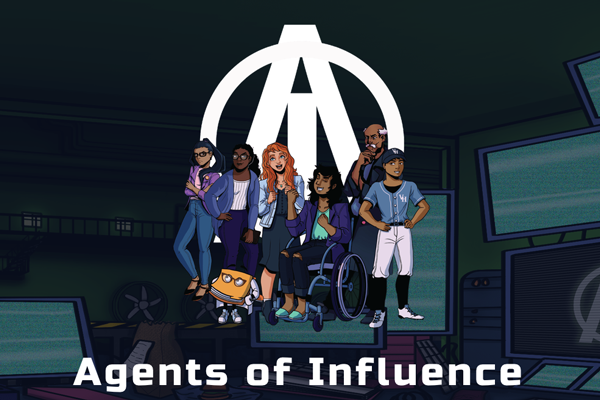
Agents of Influence (AOI) is one example of a Tier 1 strategy designed to make digital and media literacy instruction more engaging and accessible for middle and high school students. AOI is a web-based, narrative game that helps students build critical thinking and digital media literacy skills through a spy-themed storyline. Students complete missions focused on gathering and evaluating information from multiple sources, assessing credibility and evidence, identifying bias, and practicing thoughtful communication choices in digital scenarios. AOI is designed to be flexible for classroom implementation. Teachers can use the game as an independent activity, a small-group activity, or part of whole-class instruction.
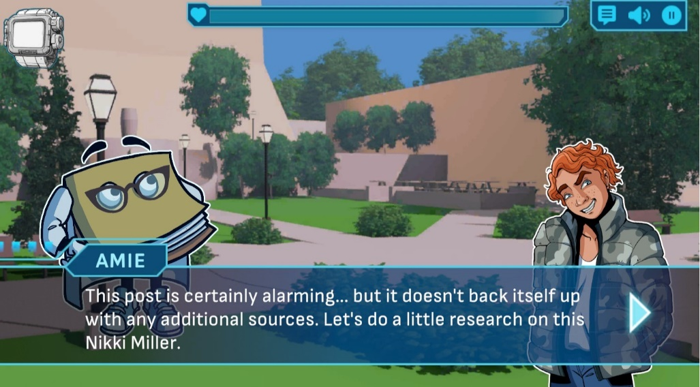
Example mission focused on preventing the spread of misinformation.
Studying AOI in Classroom Settings
Researchers at SRI Education partnered with the AOI developer, Alterea Inc., to study whether AOI could be used effectively in classroom settings and its impact on student and teacher outcomes. The randomized pilot evaluation included middle and high school teachers across several subject areas, including English language arts, social studies, media literacy, career and technical education, and computer science. Teachers were randomly assigned to either use AOI with their students or continue their typical media or digital literacy instruction over the course of approximately four weeks. The study focused on four main questions:
- Does AOI help students evaluate online information? The study assessed students’ ability to identify misinformation and evaluate online claims, evidence, and sources.
- Does AOI support students’ confidence and empathy in digital spaces? The study measured students’ digital self-efficacy and digital communication empathy.
- Does AOI support teachers’ media literacy instruction? The study examined teachers’ self-perceived competency in teaching media literacy.
- Can AOI be used during typical classroom instruction? The study team collected implementation data to understand how AOI fit into classroom instruction, including how often teachers and students used the game and how teachers integrated it into their existing routines.
What We Learned
–Grade 7 student
Across the study, AOI showed promise as a classroom-friendly approach to digital and media literacy instruction. Teachers generally found AOI easy to use and valued its ability to address media literacy topics that are often missing or only partially covered in existing curricula, including how to determine whether information comes from a reliable source, how to evaluate if the information is fair and objective, and how to use technology safely and respectfully. They also valued AOI’s ready-to-use supports, such as lesson materials, discussion questions, and tools for monitoring student progress. Students responded positively to many of AOI’s interactive and game-like features, including missions, puzzles, character dialogue, and other elements that made media literacy instruction more interactive.
Other key findings that emerged from the pilot evaluation included:
- AOI supported students’ digital communication outcomes. Students who used AOI reported significantly greater confidence in their ability to communicate, collaborate, share information, and participate appropriately in digital environments than students who received their typical instruction. Exploratory analyses also suggested that AOI may have been particularly beneficial for students who began the study with lower levels of digital communication empathy, although additional research is needed to confirm this pattern.
- Sustained engagement may matter for developing digital literacy skills. The pilot evaluation did not find clear evidence that AOI improved students’ scores on formal assessments of misinformation identification or online reasoning during the short study period. However, students who completed more AOI content tended to have stronger outcomes in identifying misinformation, reasoning about online content, and showing empathy in online communications. Because this was an exploratory finding, more research is needed to understand how much time and support students need to benefit most from AOI. Additional information about the study findings is available on SRI Education’s AOI project webpage.
–ELA, social studies, and media literacy teacher
Overall, the study points to AOI’s potential as a Tier 1 resource within an MTSS framework: an engaging, ready-to-use program that can help all students practice digital and media literacy skills as part of their typical classroom instruction. By supporting skills such as thoughtful online communication and perspective-taking, AOI may help schools address an important gap in how they support students’ digital well-being.
Educators interested in learning more about Agents of Influence can visit the AOI website to explore the program and learn about options for classroom use.
To learn more about SRI Education’s project to support the development and evaluation of the Agents of Influence game, check out the project webpage.
To learn more about using an MTSS approach to promote students’ digital well-being, check out this infographic from the Regional Educational Laboratory, Northeast & Islands.
Published August 2026.
Topics: Classroom-based intervention High school Middle school/Junior high school Multi-tiered systems of support Research design Social-emotional learning
Tags: Agents of Influence digital citizenship digital empathy digital literacy digital media literacy digital well-being educational technology game-based learning media literacy MTSS Tier 1 supports